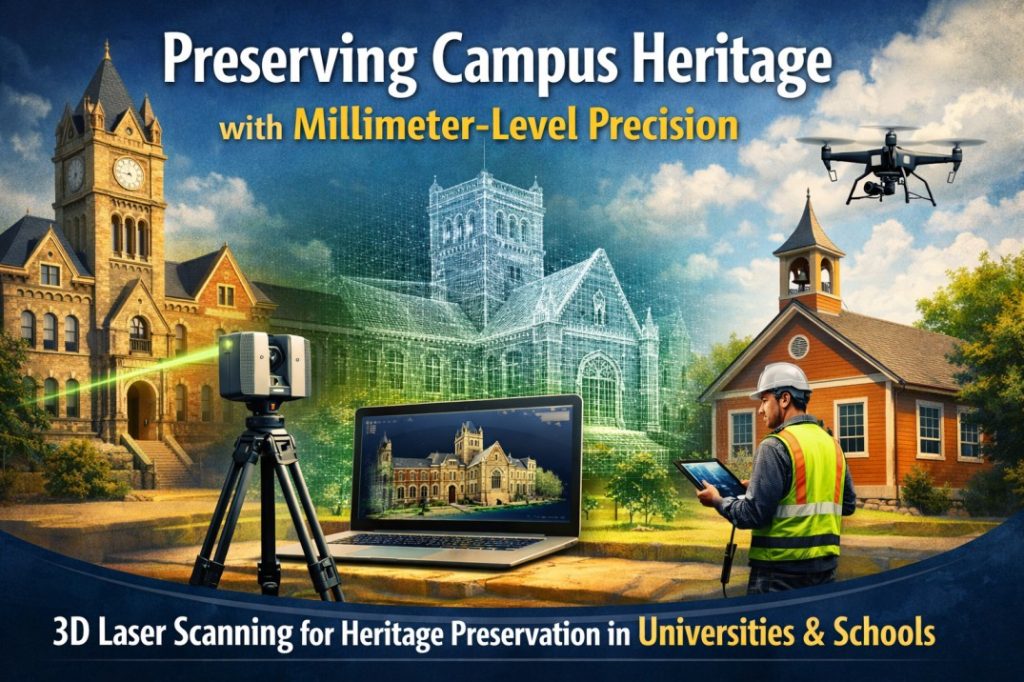
Importance of Preserving Heritage Buildings in Education
Heritage buildings on university and school campuses symbolize more than architectural beauty they embody institutional identity and cultural legacy. These structures tell the story of educational philosophies and their progress through time.
3D laser scanning for heritage preservation is becoming an essential tool for protecting these historic campus buildings. From creating accurate as-built documentation to generating point clouds, scan-to-BIM models, and digital twins, universities and schools can preserve architectural heritage while planning renovations and upgrades.
Students develop a tangible connection to previous generations of scholars in historic surroundings. This connection promotes a deeper appreciation for tradition and welcomes state-of-the-art ideas. These heritage buildings create distinctive campus characters that set institutions apart, and they often become key factors in prospective students’ decisions.
These structures work as three-dimensional textbooks from an educational perspective. Architecture students can study authentic historical construction techniques firsthand instead of relying on textbooks. Engineering classes analyze structural solutions from periods before modern technologies. Students experience art history directly within buildings that showcase the architectural styles they study. Campus heritage preservation strengthens community bonds between alumni, current students, and future generations. These buildings remain symbols of institutional permanence and stability in our faster-changing times.
Balancing preservation with modern educational needs presents a significant challenge. 3D laser scanning for heritage buildings is a powerful way to capture precise documentation of these structures before, during, and after modifications or restorations. Institutions protect their physical history while adapting to contemporary requirements by creating digital twins of these educational landmarks.
How 3D Laser Scanning Documents Historic Campuses
3D laser scanning technology has revolutionized the documentation of historic educational campuses. This advanced process captures highly accurate spatial data and creates detailed three-dimensional digital representations called point clouds. These scanners measure distances to surrounding surfaces with remarkable precision by emitting millions of laser pulses per second. They typically achieve accuracy between 2-5mm.
- The technology captures the true condition of aging campus structures perfectly. Laser scanning documents the exact “as-is” state, unlike traditional measurement methods.
- It records leaning walls, sagging floors, and other irregularities that develop over time.
- This precision is vital for educational institutions with historic buildings that often lack accurate as-built documentation.
Modern scanning systems offer speed as their biggest advantage. Teams can now complete in minutes what once took hours at the same coverage and resolution. The equipment has become more portable, which allows complete documentation from exterior facades to interior rooms and from cellars to attics.
Architects and preservationists can use the resulting point cloud data to generate precise CAD drawings, orthographic images, 3D models, and virtual tours. These digital twins aid maintenance planning and create permanent archives. The archives provide vital insurance against potential damage or future renovations.
The technology does have its limits. Scanners need direct line of sight to collect data and have trouble with dark colors or highly reflective surfaces like glass. Complete documentation often combines scanning with traditional measurement techniques.
Ensuring Structural Safety of Old Educational Buildings
Historic educational buildings pose unique challenges when assessing their structural safety because of their age and modifications that lack proper documentation.3D laser scanning has become a vital tool that helps conduct accurate structural analysis.
- This technology makes reverse engineering possible by comparing a building’s current “deformed state” with its theoretical “original state” through visual programming algorithms.
- Engineers can now understand how displacements and deformations impact masonry, columns, and timber components over time.
- Point cloud data goes beyond simple documentation by feeding directly into Finite Element Method (FEM) analysis.
- Engineers can now work with the actual geometry of deteriorated structural elements.
- This precision is essential since eroded stone columns’ maximum stress concentrations can be much higher than idealized models, and sometimes reach material compressive strength limits.
- Educational institutions that manage aging buildings with safety concerns find 3D scanning extremely valuable.
- The technology captures exact measurements of sagging floors, leaning walls, and irregularities that develop over decades.
- The collected data also supports predictive maintenance approaches, helping teams identify potential structural risks earlier.
- The scanning process also improves fire safety assessments.
This capability is vital since builders constructed many heritage educational buildings before modern fire protection standards existed. Digital documentation helps institutions plan appropriate modernization while maintaining their historical integrity.
What are Key Deliverables from 3D Laser Scanning for Heritage Preservation?
A major advantage of reality capture for heritage sites is that institutions can choose deliverables based on their renovation, restoration, documentation, or facilities management needs. Typical deliverables from heritage laser scanning projects include:
- Registered point cloud datasets (E57 / RCP / LAS formats)
- 2D as-built drawings (floor plans, elevations, sections)
- Scan-to-BIM or HBIM models (Historic Building Information Modeling) for restoration planning
- Orthographic images / facade orthophotos for detailed conservation work
- Deviation analysis and deformation maps to identify movement or irregularities over time
- Virtual tours and interactive walkthroughs for teaching, planning, and public engagement
- Digital twin datasets that support long-term asset and maintenance planning
These outputs help universities and schools create a reliable foundation for future renovations while protecting heritage integrity.
Creating Digital Archives for Future Generations
3D laser scanning has opened new possibilities to protect our educational heritage, especially in universities and schools with historic campus buildings. Digital twins created from detailed scans of these heritage structures serve as powerful digital archives that anyone can access anywhere, anytime. As physical archives age and become harder to preserve, many institutions are accelerating digitization efforts to prevent permanent loss of historic documentation and building records. Through heritage laser scanning and reality capture, universities can preserve the “as-is” condition of their landmark buildings while building a reliable foundation for future restoration and campus planning.
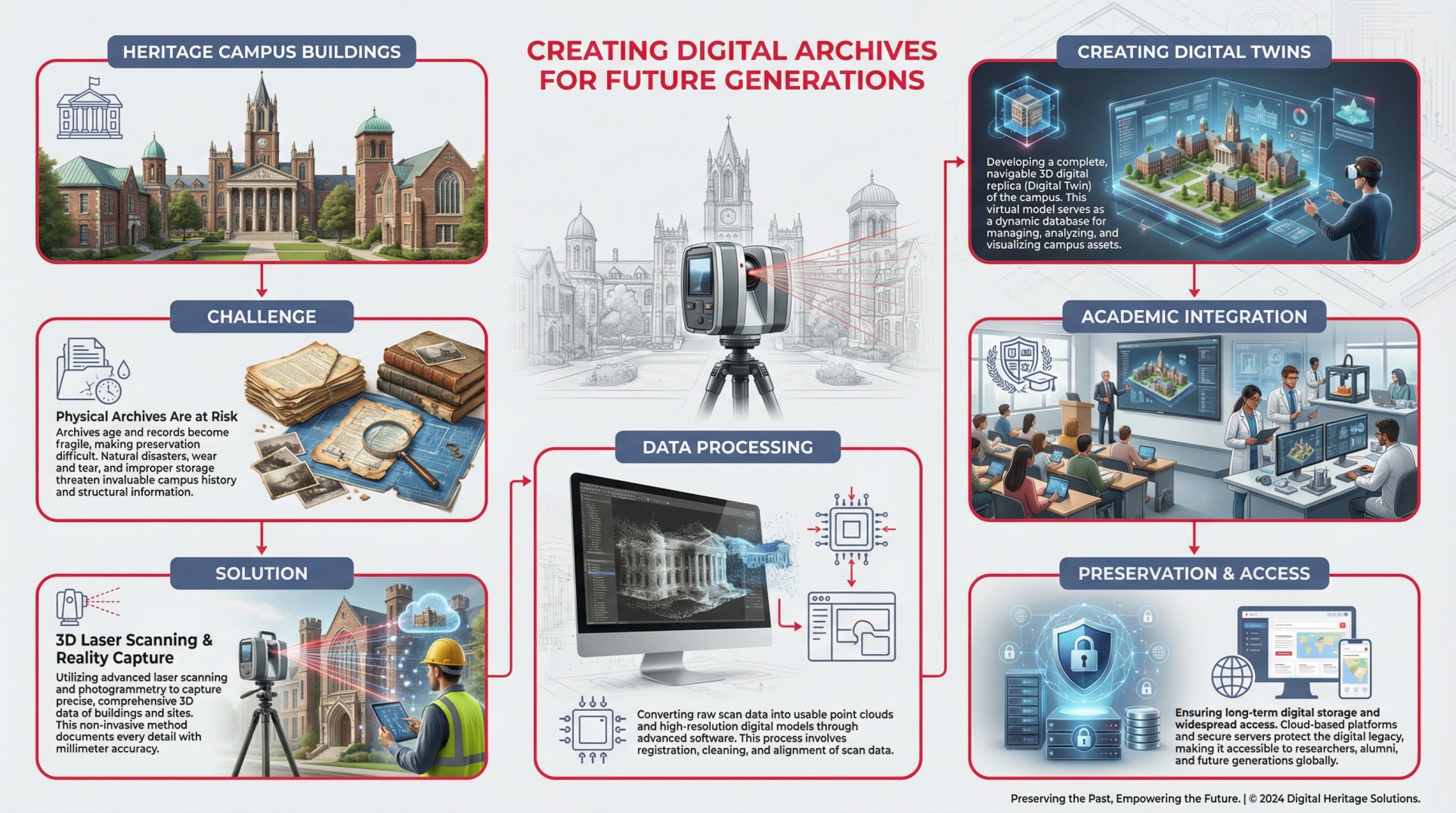
Creating digital archives through 3D laser scanning for heritage preservation allows universities and schools to protect historic campus buildings while ensuring long-term accessibility for students, researchers, and alumni. By converting heritage structures into digital twins, institutions preserve irreplaceable documentation, support restoration and renovation planning, and reduce dependence on fragile physical records. In an era when modernization is essential, heritage laser scanning and reality capture ensure campus history remains accurately documented, accessible, and preserved for generations to come.
Implementation Planning for Campus Heritage Scanning Projects
Smart planning and careful resource allocation make 3D laser scanning work well in educational heritage settings. Schools save time and avoid costly rework when they integrate scanning into their maintenance plans early instead of waiting for issues to surface.
Heritage scanning projects on campus generally move through five stages: the original assessment, selecting equipment, capturing data, processing it, and connecting everything to facility management systems. Getting the right balance between precision and budget matters a lot. Heritage-specific scanning equipment prices range widely depending on accuracy needs and project scale.
The upfront costs might seem high, but schools see the bigger picture. Institutions with ongoing 3D documentation programs often reduce long-term historic building maintenance costs by identifying issues early and improving renovation accuracy. Students also benefit campuses increasingly use heritage scanning data in teaching materials, which boosts engagement and supports hands-on learning.
Managing all the data creates some technical hurdles. A single campus scan can create very large point cloud datasets that require secure storage, structured workflows, and specialized processing. That’s why many universities team up with their IT departments or bring in outside experts rather than handling everything alone.
Technology keeps getting better and more accessible. As equipment becomes more efficient and workflows become more streamlined, these preservation tools are increasingly feasible for schools and universities of all sizes.
Where Laser Scanning Fits in Active University and School Environments
Universities and schools differ from typical heritage projects because the campus is often occupied and operational. That makes scheduling and coordination just as important as technical accuracy.
3D laser scanning for university historic buildings is especially valuable because teams can work in short scanning windows, between classes, during breaks, or in scheduled facility shutdowns. For large campuses, scanning also supports consistent documentation standards across multiple buildings, which improves planning for phased renovations and long-term campus master planning.
Institutions can also combine scanning results with safety, accessibility, and modernization requirements, helping teams upgrade systems while respecting the historic character of the building.
Case Studies of University Heritage Conservation
Universities are increasingly using 3D laser scanning for heritage preservation to document historic buildings, replace outdated drawings with accurate as-built data, and create long-term digital records for restoration and campus planning.
- University of Chicago: Laser Scanning for Historic Campus Documentation
- The University of Chicago implemented a large-scale laser scanning program to document its historic Main Quadrangle buildings.
- The goal was to create reliable, measurable “as-is” records that facilities and design teams could use for renovation planning, upgrades, and long-term building stewardship.
- The scanned data helped address a common campus challenge, legacy drawings that are incomplete or inaccurate after decades of changes.
- University of Michigan: Digital Twin Preservation for an Endangered Historic Site
- The University of Michigan’s Taubman College of Architecture and Urban Planning used laser scanning at the former Packard Automotive Plant in Detroit to support a preservation strategy for buildings facing demolition.
- By capturing the site through 3D scanning and creating a digital twin, the project ensured a permanent digital record of the structure’s geometry and spatial character, even if the physical building no longer exists.
These case studies show how 3D laser scanning supports both campus-scale heritage documentation and risk-based digital preservation, helping universities protect historic architecture while planning for modernization and future use.
Conclusion
Heritage buildings on campuses were never meant to stand still, they were built to evolve with education. The difference today is that universities no longer have to choose between preserving history and upgrading for modern needs. With 3D laser scanning, institutions can capture a building’s exact truth, its geometry, its irregularities, its hidden risks, and turn that reality into a usable digital foundation for every future decision.
In the long run, the strongest preservation strategy won’t be the one that restores the most beautifully, but the one that documents the most intelligently. Because when renovations begin, disasters strike, or buildings simply age, the institutions that will protect their legacy best are the ones that already have it captured, accurately, accessibly, and permanently.