
What Is Architectural BIM Modeling?
BIM Modeling in architecture has transformed traditional design methods completely. In comparison to standard CAD systems BIM creates intelligent, data-rich 3D models . This digital model show both physical and functional aspects of buildings and infrastructure.
BIM Modeling in architecture creates complete digital models with detailed information about building layouts, spatial relationships, and architectural elements like walls, windows, and doors. These models become valuable knowledge resources throughout a building’s life – from design to demolition.
BIM goes beyond three spatial dimensions to include time (4D), cost (5D), sustainability (6D), operations (7D), and safety (8D) . Data center design services benefit as each model element – from server racks to cooling systems – contains parametric data about its properties, relationships, and attributes.
For data centers, BIM goes beyond architecture:
- It integrates structural systems,
- coordinates MEP (Mechanical, Electrical, Plumbing),
- aligns with fire & life-safety codes, and
- ensures redundancy planning (N, N+1, 2N).
Architectural BIM becomes the single source of truth, enabling every discipline to collaborate and stay consistent using coordinated, clash-free information.
Architects use several essential BIM tools: Revit for parametric 3D modeling, Navisworks to detect clashes, and BIM 360 for team collaboration in the cloud.
Key Challenges in Data Center Design (Where BIM Makes the Difference)
Data center power needs are expected to increase by 160% by 2030 U.S. facilities will account for up to 60% of total load growth from 2023 through 2030. Grid connection timelines have stretched from 2-3 years to 4-8 years in many locations, creating serious bottlenecks for developers.
A talent shortage makes these problems worse. Site selection adds more complexity to the process. Developers must deal with environmental regulations, zoning hurdles, and local community’s concerns about noise and appearance. Supply chain problems continue to pose risks and affect power systems and cooling equipment. Extended lead times for specialized components often delay construction schedules.
Designing a mission-critical facility involves solving complex problems:
- High HVAC loads requiring precise airflow modeling
- Redundancy planning for power distribution (N, N+1, 2N)
- Dense cable routing and equipment pathways
- Raised floor & overhead containment systems
- High structural load on slab & rack zones
- Seismic, fire, & code compliance
- Tight construction schedules & large budgets
How Architectural BIM Modeling Transforms Data Center Design
BIM has reshaped the scene for data center projects in states like Texas, Virginia, and Arizona. The technology helps teams visualize dense MEP systems that vie for space in these mission-critical facilities.
Precision in Space Planning & Server Hall Layout
Data centers are high-performance machines-every square foot matters. So, the level of accuracy prevents costly field rework later.
- Accurate rack and containment layout
- Optimized cold aisle & hot aisle planning
- Correct zoning of white space, gray space, and support areas
- Accurate clearances for maintenance paths
- Better future expansion planning
Enhanced MEP–Structural–Architectural Coordination
Data centers are 60–70% MEP by cost. Using BIM-based clash detection, conflicts are resolved virtually-not on the job site.
- Zero clashes in ducts, conduits, cable trays, chilled water loops
- Proper alignment with structural beams & columns
- Accurate placement of CRAH/CRAC units
- Coordination of battery rooms, UPS, generators, fire systems
Accurate Modeling for Cooling & Airflow Management
Efficient cooling is mission-critical. With BIM, mechanical coordination becomes precise, reducing downtime and heat-related failures.
- CFD-ready 3D models
- Hot aisle/cold aisle airflow optimization
- Proper placement of cooling units
- Integration of economizers, plenum spaces, CRAC units
BIM-Integrated Redundancy (N, N+1, 2N)
Data centers require fault tolerance. Architectural BIM supports redundancy planning by mapping:
- Multiple electrical paths
- Dual mechanical pathways
- UPS and battery room layouts
- Emergency generator spacing
- Fire suppression access
With BIM, mission-critical redundancy becomes deterministic—not guesswork.
Code Compliance for U.S. Data Center Construction
Architectural BIM helps teams meet:
- NEC (National Electrical Code)
- NFPA (Fire Protection Standards)
- ASHRAE Thermal Guidelines
- IBC structural standards
- Local state & county AHJ permitting guidelines
BIM provides accurate submittals for faster approvals from U.S. authorities.
Prefabrication & Modular Data Center Support
Modular and prefabricated data centers (PODs) are rising.
BIM enables:
- Prefab-ready component modeling
- Factory-level geometry precision
- Construction simulation & sequencing
- Reduced on-site installation time
This aligns with hyperscale data center delivery speed.
Lifecycle Management & Digital Twin Integration
After construction, BIM becomes the backbone of facility operations:
- Real-time equipment condition updates
- Asset management and maintenance
- Energy efficiency monitoring
- Operations sequencing
- Risk detection
Data centers run 24/7 – so an accurate digital twin is invaluable.
Architectural BIM Deliverables for Data Center Projects
- LOD 300–500 BIM models
- Data hall layouts
- Room zoning & rack placement
- Containment modeling (hot/cold aisle)
- Floor, wall, and ceiling architecture
- MEP–structural coordination models
- Fire rating plans
- Equipment schedules
- BIM-based AHJ submittal drawings
- As-built BIM models for operations
Key Architectural BIM Deliverables for Data Centers
Architectural BIM’s real value for data centers comes from its tangible deliverables that boost project success in states like Texas, Virginia, and Arizona. These specialized outputs deliver much more than simple 3D visualization.
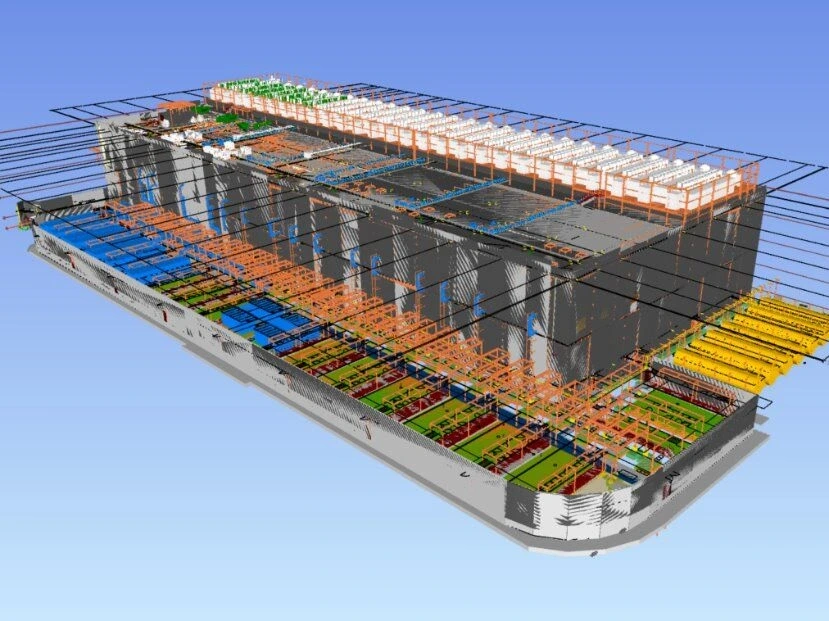
Coordinated 3D models form the core of BIM deliverables by combining architectural, structural, and MEP systems in a unified digital environment. Detailed clash detection reports identify spatial conflicts can be identified between overlapping ducts, conduits, pipes, and structural elements before construction starts. To analyze airflow patterns in hot and cold aisles, confirm rack layouts, and optimize cooling unit placement CFD-integrated models are required
Teams receive fabrication ready model built to LOD 400 (Level of Development) specifications, with exact component details, hanger locations, and connection points.
Key deliverables include:
- Detailed underfloor layout models with ducts, cabling trays, and power runs.
- Detailed documentation with floor plans, sections, and 3D views.
- As-built models containing equipment data, maintenance schedules, and system specifications.
- BIM Execution Plans (BEP) that outline stakeholder roles, data exchange formats, and regulatory compliance.
Why Modular Data Center Market will grow?
BIM’s value shines through successful implementations in a variety of data center projects throughout the United States. Amazon’s Quail Ridge hyperscale campus in Virginia’s Loudoun County demonstrates how integrated 3D models coordinated complex dry and wet utilities across a massive 2.47 million sq. ft. site. The project reduced risks through early conflict detection and enabled quick expansion planning.
An AWS data center in Fairfax County achieved remarkable results with BIM: 99% “First-Time-Right” accuracy and 30% less rework. This precision led to faster installation in a high-security environment where delays could get pricey.
BIM applications show different benefits for each facility type:
- Hyperscale centers in California cut project delivery time by 25% by using BIM for prefabricated MEP skids.
- Colocation facilities in Europe reduced commissioning delays by 15% through multi-stakeholder BIM coordination.
- Enterprise data centers employ BIM to integrate high availability and security.
- Edge computing centers employ BIM to maximize space and speed up deployment.
- Specialized facilities like cryptocurrency mining centers use standardized BIM designs.
These soaring wins help explain why the modular data center market will grow from $23 billion in 2022 to $88.5 billion by 2030.
How TopBIM Company Improves U.S. Data Center Construction
TopBIM enhances data center delivery by improving coordination, speeding up schedules, and reducing construction risks. Our work includes:
- Clash-free Arch–MEP–Structural models for seamless construction
- 4D BIM sequencing to accelerate fast-track builds
- Prefab-ready BIM outputs for PODs and modular systems
- CFD-ready layouts for optimized cooling and airflow
- Compliance-focused modeling aligned with NEC, NFPA, ASHRAE
- 5D quantities for accurate budgeting and cost control
- Early constructability checks to prevent delays
- LOD 500 as-builts to support digital twins and operations
Key Takeaways
BIM technology has become essential for data center design, transforming complex infrastructure projects through intelligent 3D modeling and comprehensive coordination capabilities.
- BIM reduces construction time by 70% – Projects drop from 36 weeks to just 16 weeks when combining BIM with prefabricated modules, dramatically improving efficiency.
- Early clash detection prevents costly rework – BIM identifies spatial conflicts between MEP systems before construction, catching hundreds of potential issues that would cause delays.
- Thermal modeling optimizes cooling performance – CFD-integrated BIM models analyze airflow patterns and prevent equipment-damaging hotspots in mission-critical facilities.
- MEP systems require specialized coordination – Data centers consume 50-600 watts per square foot versus 2 watts for offices, demanding precise mechanical and electrical integration.
- Choose partners with proven data center expertise – Select BIM firms with Tier certification knowledge, advanced clash detection capabilities, and real-time cloud collaboration tools. There are experienced BIM consulting companies in U.S.
The combination of BIM’s intelligent modeling capabilities with data center-specific expertise creates a powerful foundation for delivering these complex, mission-critical facilities on time and within budget while ensuring optimal performance throughout their operational lifecycle.