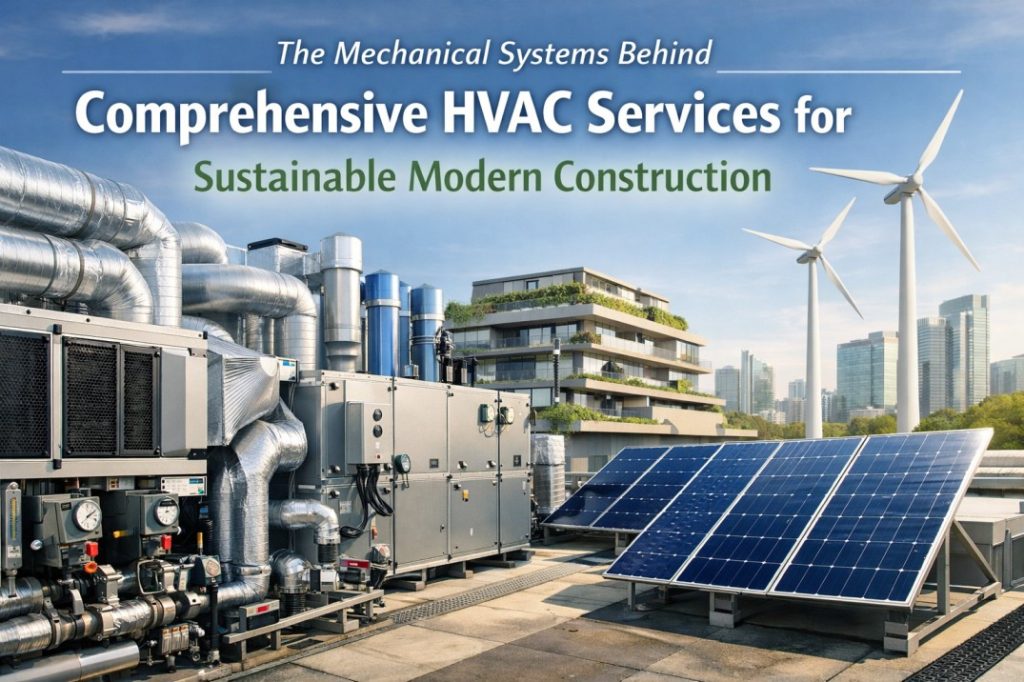
Modern construction has changed the expectations placed on building systems. Owners want performance. Occupants expect comfort. Developers look for energy savings, faster delivery, and fewer coordination issues. That is exactly why HVAC services in construction now carry more weight than ever before.
They are no longer limited to heating and cooling equipment alone. Today, HVAC services in construction cover design strategy, ventilation planning, code compliance, execution support, commissioning, and digital coordination. In high-performance projects, they also connect directly with prefabrication, clash resolution, and long-term operational efficiency.
The real shift is this: HVAC is no longer just a mechanical scope. It is a building performance system. For modern project teams, well-planned HVAC services in construction support performance, coordination, and long-term operational value from the earliest design stage.
Overview of HVAC Services in Construction
At a basic level, HVAC work is responsible for controlling indoor temperature, airflow, humidity, and air quality. But in actual project delivery, the scope is much broader.
HVAC services in construction usually include:
- heating and cooling load calculations
- equipment selection
- duct and piping layout
- controls planning
- ventilation strategy
- installation support
- testing and balancing
- commissioning and handover validation
Why does this matter so much in modern buildings?
Because HVAC systems influence:
- comfort
- safety
- indoor environmental quality
- operating cost
- maintenance access
- compliance with building codes
That is why strong HVAC services in construction have to begin early. When HVAC decisions are delayed or poorly coordinated, the result is rarely minor. It often shows up as ceiling congestion, costly rerouting, rework in the field, or inefficient building operation after handover.
Types of HVAC Services for Construction Projects
Not every building needs the same HVAC approach. A residential tower, a hospital, an office building, and an industrial plant all demand different mechanical strategies.
By project type
- Residential projects: These projects usually focus on occupant comfort, zoning flexibility, and cost-effective operation. Common systems include split units, heat pumps, and VRF setups.
- Commercial projects: This is where HVAC design for commercial buildings becomes more complex. Offices, hotels, retail spaces, schools, and mixed-use developments require careful attention to occupancy shifts, ventilation rates, and system control.
- Industrial and mission-critical projects: These environments often need specialized air handling, process cooling, filtration control, or temperature stability. Mechanical failure in such spaces can affect production, equipment reliability, or compliance.
By system approach
A second way to evaluate project needs is through system architecture.
System Type | Best Fit | Main Advantage |
Centralized HVAC | large buildings, campuses, high-load facilities | better central control and energy management |
Decentralized HVAC | smaller buildings, phased developments, retrofits | flexible zone-level operation |
The right answer depends on how the building will function day to day. Good design starts there, not with equipment catalogs.
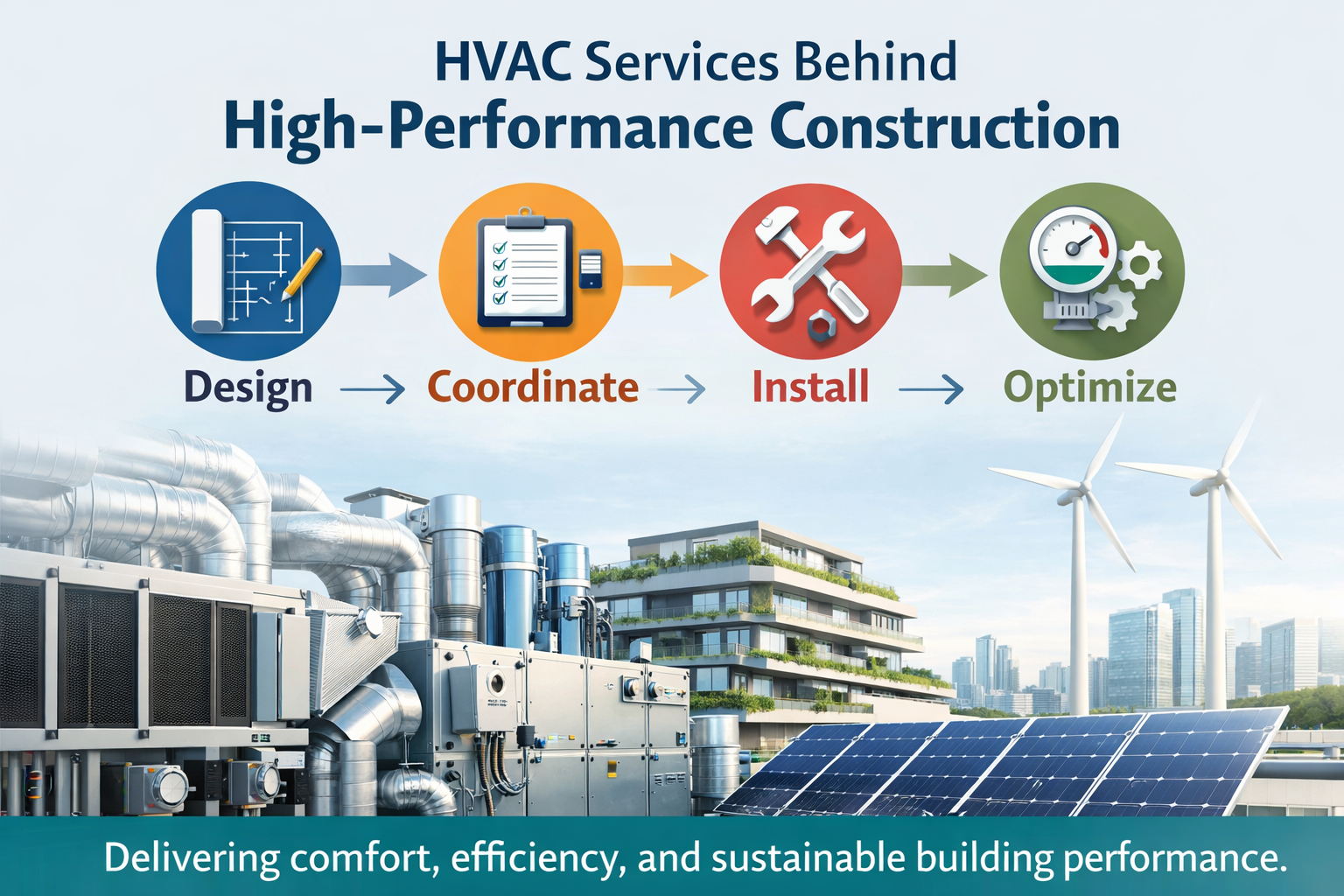
This workflow reflects how HVAC design for commercial buildings now depends on early planning, digital coordination, and buildable execution.
HVAC Design and Planning Process
Strong performance begins before the first duct is fabricated. It starts in planning.
- Load calculations
This stage determines how much heating and cooling the building truly needs. Engineers review:
- Climate conditions
- Building orientation
- Occupancy density
- Façade performance
- Lighting and equipment loads
- Ventilation demand
Without accurate loads, even the best-looking design can fail in operation.
- Systemselection
This is the stage where the team decides whether the project is better served by chillers, packaged units, VRF systems, DX systems, or hybrid arrangements.
For larger facilities, HVAC design for commercial buildings usually requires deeper comparison across lifecycle cost, space constraints, and control requirements. In many cases, HVAC design must balance energy targets with real construction limitations, especially in tight ceiling zones or retrofit conditions.
- Layout and routing
Ducts, piping, plant rooms, shafts, and service clearances must fit the architectural and structural reality of the building.
Poor routing decisions lead to:
- Clashes with beams
- Restricted ceiling heights
- Difficult access for maintenance
- Field-level changes that delay installation
- Code and compliance review
Every system must satisfy mechanical codes, fire and smoke control standards, ventilation requirements, and energy regulations.
- Constructability validation
This is where well-developed HVAC design for commercial buildings separates itself from generic drafting. The question is not just whether the system works on paper. The question is whether it can be built efficiently, safely, and without unnecessary redesign.
Role of BIM in Delivering Efficient HVAC Services
This is one of the most important changes in how mechanical scopes are delivered today. Today, BIM for HVAC systems helps teams make faster coordination decisions before fabrication and site installation begin.
BIM for HVAC systems provides project teams with a digital environment to coordinate ducts, pipes, equipment, and access zones before installation begins. That reduces guesswork and turns coordination into a preconstruction activity rather than a field problem.
What BIM changes
With BIM for HVAC systems, teams can:
- Visualize the full mechanical layout in 3D
- Identify conflicts with structure and other trades
- Improve duct and pipe routing
- Validate service access
- Support prefabrication decisions
- Plan installation sequencing with greater accuracy
Why coordination matters
HVAC systems compete for space with electrical, plumbing, fire protection, and structural elements. That is why MEP coordination services are essential in complex buildings. Without proper coordination, trades end up negotiating space on site, often after fabrication has already started.
Well-executed MEP coordination services help project teams:
- Detect clashes early
- Reduce RFIs
- Minimize site rework
- Improve trade sequencing
- Protect schedule certainty
Where modeling adds value
Detailed HVAC modeling services take the process further. Instead of using models only for review, teams can apply them for fabrication-level planning, spool development, and installation support.
On technically demanding projects, HVAC modeling services are often used to support spool-level detailing, prefabrication logic, and field-ready coordination.
In practice, HVAC modeling services are valuable for:
- Shop drawing production
- Prefabrication workflows
- Hanger and support planning
- Field coordination
- High-density MEP zones
The real strength of BIM for HVAC systems is not visual appeal. It is predictability. Combined with strong MEP coordination services, it helps teams solve problems before those problems become change orders.
HVAC Installation and Commissioning
Design creates intent. Installation proves whether that intent was practical.
The HVAC installation process should follow a disciplined sequence rather than a fragmented trade-by-trade approach.
Typical HVAC installation flow
Step 1: Equipment placement: Air handling units, chillers, pumps, terminal devices, and condensers are positioned with required clearances and structural support.
Step 2: Duct and piping installation: Main duct routes, branch ducting, chilled water lines, refrigerant piping, and drainage systems are installed according to approved layouts.
Step 3: Controls and system connection: Mechanical systems are linked to controls, sensors, electrical interfaces, and automation logic.
Step 4: Testing and balancing: The system is checked for pressure stability, leakage, airflow quality, and water balance.
Step 5: Commissioning: Final validation confirms that the system performs according to design and owner requirements.
A weak HVAC installation process often causes hidden issues that surface only after occupancy. Common examples include poor airflow distribution, inaccessible valves, duct leakage, control instability, and uneven zone performance. A disciplined HVAC installation process avoids those issues by linking field execution with design intent, testing, and performance verification.
Energy-Efficient and Sustainable HVAC Solutions
Efficiency is no longer a bonus. It is part of the project brief. Owners increasingly ask for lower lifecycle costs, lower emissions, and better indoor environmental quality. That has made energy-efficient HVAC systems a core requirement across many building types.
What makes a system energy efficient?
The answer is not just “high-efficiency equipment.” Real performance usually depends on a combination of:
- Correct sizing
- Zoning strategy
- Variable speed operation
- Smart controls
- Demand-based ventilation
- Heat recovery
- Reduced distribution losses
Why sustainable HVAC matters now
For owners focused on lifecycle value, energy-efficient HVAC systems offer a practical path to lower operating costs and stronger environmental performance.
Energy-efficient HVAC systems support both operational savings and broader sustainability goals. They help owners reduce utility costs, improve system responsiveness, and align with green building standards.
They also improve the indoor environment through:
- Better ventilation
- Improved humidity control
- Healthier air quality
- More stable comfort conditions
Common sustainable priorities in modern projects
Many project teams now look for:
- Low-energy system configurations
- Automation-ready controls
- Better occupancy response
- Reduced carbon impact
- Support for certifications and ESG targets
Well-designed energy-efficient HVAC systems are not only efficient in theory. They are built to perform under real use conditions. That is the difference. For long-term building value, energy-efficient HVAC systems should be considered at the design stage, not added later as an afterthought.
Choosing the Right HVAC Services Provider
Not every firm offering HVAC support brings the same depth of capability. Some teams can draft. Fewer can coordinate. Even fewer can support complex construction delivery from design through commissioning.
A reliable provider should bring a mix of engineering judgment, coordination experience, and digital execution support.
Look for these capabilities
- proven project experience across sectors
- code and compliance familiarity
- constructability understanding
- BIM-based workflow support
- responsive project coordination
- testing and commissioning awareness
A practical selection checklist
Choose a team that can support:
- design accuracy
- constructable layouts
- digital coordination
- detailed HVAC modeling services
- fabrication support where needed
- field-level issue resolution
On complex projects, good providers do more than issue drawings. They stay engaged through coordination reviews, design updates, and performance validation. That is especially true when HVAC modeling services are being used to support prefabrication or high-density building zones.
Final Thoughts
Modern buildings demand more from their mechanical systems, which has raised the value of integrated HVAC delivery.
From early planning to commissioning, every phase affects performance. Better HVAC services in construction reduce coordination risk, improve building quality, and support long-term efficiency. Stronger HVAC design for commercial buildings helps teams align performance goals with real project conditions. Smart use of BIM for HVAC systems improves visibility before work reaches the field. Reliable MEP coordination services reduce trade conflicts. Detailed HVAC modeling services support constructability and prefabrication.