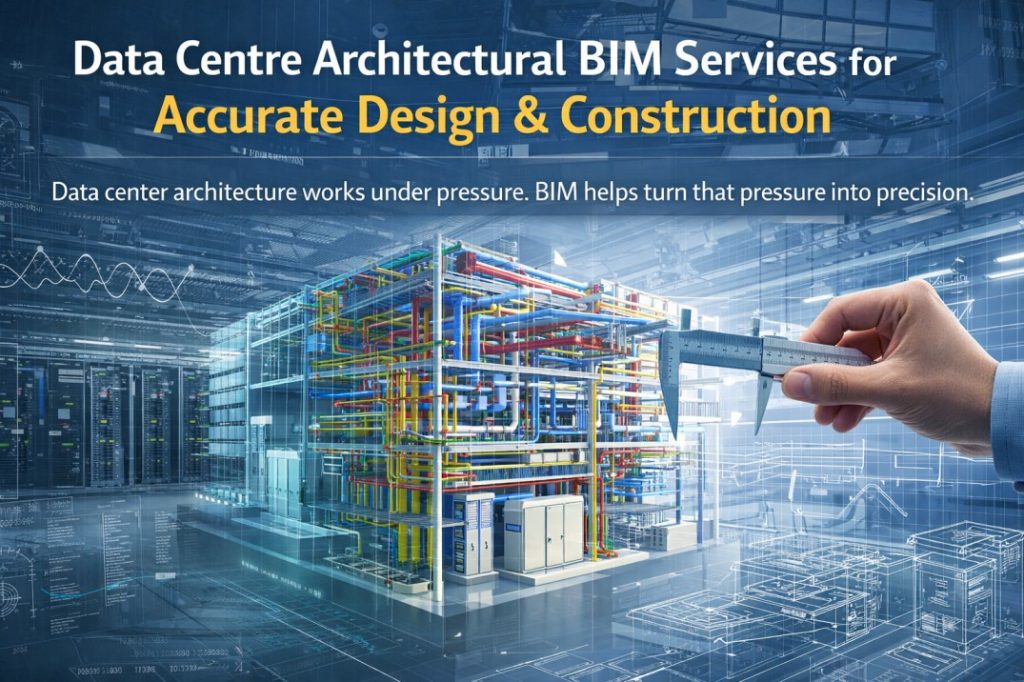
Data center architecture is shaped by more than design intent. It is shaped by precision. A corridor has to preserve access. A wall has to work around equipment zones. A facade must align with envelope performance, detailing, and coordination of demands. In these environments, architectural decisions do not stay isolated for long. They affect documentation quality, multidisciplinary coordination, and construction execution.
To achieve the level of precision in a data center, data center architectural BIM services become essential. In hyperscale and enterprise projects, architectural Building Information Modeling has to do more than represent a building in 3 dimensions. It must support planning, validate design intent, improve coordination, and reduce uncertainty before work reaches the site. With expertise in architectural BIM modeling data center workflows, Revit-based development, facade detailing, and shop drawings, the focus stays on building models and documentation that are accurate, coordinated, and ready for delivery. Through architectural Revit modeling data center services, project teams gain stronger control over design development and construction outcomes.
Our Data Center Architectural BIM Services
Architectural BIM Modeling for Data Centers
In mission-critical environments, modeling is not just a design exercise. It is a coordination tool. Architectural BIM modeling data center projects help define the spaces that support server infrastructure, circulation, operational access, and facility-wide planning long before construction begins.
Service scope includes:
- Detailed architectural BIM models for data center facilities
- Planning support for server halls, corridors, rooms, and functional areas
- Model-based inputs for design review and downstream coordination
Project value:
- Better spatial clarity during design
- Improved alignment with engineering disciplines
- Stronger control over architectural intent
- Fewer coordination surprises during execution
Architectural Revit Modeling for Data Center Projects
Revit plays a central role in data center architecture because it supports both precision and flexibility. Parametric modeling allows design teams to refine layouts, validate decisions, and manage revisions without losing model consistency. That is why Revit modeling for data center architecture is often central to design development and BIM-led documentation workflows.
Sr. No. | What does Architectural Revit Modeling Include? | Why does it matter to Data Center Projects? |
1 | Autodesk Revit-based Architectural Modeling | Improves Model accuracy across project stages. |
2 | Parametric BIM components | Supports efficient updates and controlled revisions |
3 | Design validation | Helps review layouts, alignments, and planning assumptions |
4 | Structured model development | Strengthens coordination with engineering teams
|
Used well, Revit does more than produce clean models. It supports informed architectural decision-making in highly constrained project environments.
Architectural Shop Drawings for Data Centers
In data center construction, shop drawings need to be direct, coordinated, and field-ready. They are not just documentation outputs. They are working instruments that help teams interpret design intent accurately during execution. High-quality architectural shop drawings BIM data center teams rely on should translate complex model information into clear, construction-ready outputs.
Deliverables may include:
- Construction-ready architectural shop drawings
- Room layout and partition detailing
- Wall assembly documentation
- Coordination drawings linked to execution needs
- Detailed architectural sheets for field interpretation
What this improves:
- Drawing clarity during installation
- Reduced ambiguity for site teams
- Better coordination across packages
- Smoother translation from model to construction
Facade BIM Modeling Services for Data Centers
The facade in a data center project is often viewed as a secondary architectural layer. In practice, it carries substantial coordination and detailing responsibility. Envelope systems have to be modeled with enough discipline to support both design quality and constructability. Strong facade BIM modeling services data center teams provide help in resolving these interface conditions early.
Facade BIM modeling support covers:
- Exterior facade BIM development
- Curtain wall system modeling
- Cladding and envelope detailing
- Interface coordination with structural and architectural systems
Why it matters:
- Improves envelope detailing accuracy
- Clarifies system interfaces early
- Supports cleaner coordination during documentation
- Reduces uncertainty in complex facade conditions
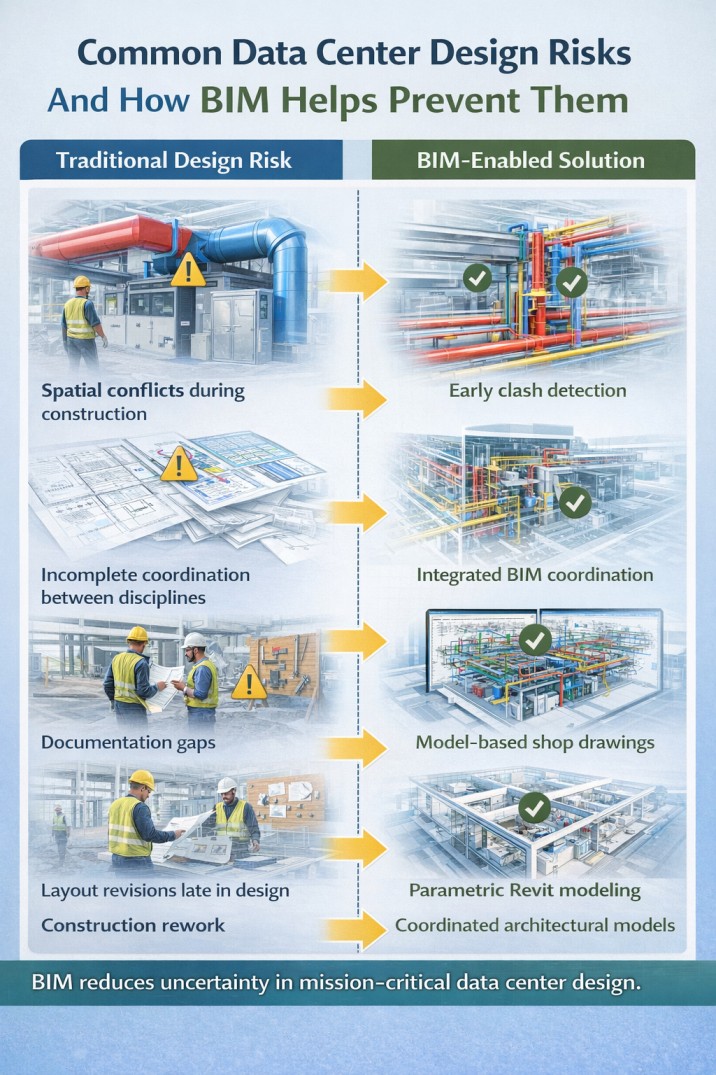
Coordination is where architectural BIM proves its value most clearly in data center projects. Tight spaces, dense systems, and overlapping packages create very little tolerance for unresolved conflicts. Teams that provide architectural coordination BIM services data center support help reduce rework risk before construction begins.
Coordination support includes:
- Clash detection and model review
- Architectural coordination with MEP and structural teams
- Shared BIM collaboration workflows
- Constructability-focused issue resolution
Sr. No. | Coordination challenge | BIM-led response |
1 | Tight spatial constraints | Early conflict visibility |
2 | Model overlap across disciplines | Better alignment between teams |
3 | Rework risk in the field | Issues resolved before construction |
4 | Incomplete coordination outputs | Clearer, model-based documentation |
Why Choose TopBIM Company’s Architectural BIM Consultants for Data Center Projects
Data center work requires more than software proficiency. It requires consultants who understand how architectural models influence coordination, delivery speed, and execution quality in high-density environments. Experienced architectural BIM consultants for data center projects bring that project awareness into every model, drawing set, and coordination workflow.
What sets the TopBIM company team apart
- Experience supporting data center project requirements
- Advanced use of Revit and Navisworks for modeling and coordination
- Dedicated BIM specialists focused on architectural scope
- Global delivery capability for scalable project support
- Strong integration with architect, contractor, and developer workflows
Why clients value this approach
- Better technical consistency across deliverables
- Faster response to modeling and documentation needs
- Coordination support aligned with project realities
- Dependable production capacity for complex project timelines
Benefits of Outsourcing Architectural BIM for Data Centers
Many firms choose to outsource architectural BIM for data centers when it comes to high-dependency digital infrastructure. This is beneficial especially when project schedules tighten, packages multiply, or internal production bandwidth becomes limited. It is often a practical way to increase delivery capacity without expanding fixed overhead.
| Benefit | Data Center Project Impact |
1 | Reduced project costs | Lowers in-house production overhead |
2 | Faster delivery | Expands modeling capacity during active phases |
3 | Skilled BIM experts | Adds specialized support without long hiring cycles |
4 | Scalable project support | Adjusts to workload changes more easily
|
Why outsourcing works well for data centers
- Timelines are often compressed
- Coordination requirements are intensive
- Documentation quality has to stay high under pressure
- Production support needs can shift quickly from phase to phase
Outsourcing is most effective when it strengthens delivery without weakening control. That is the value a structured BIM support model is meant to provide.
Our BIM Workflow for Data Center Construction Projects
A reliable architectural BIM company for data center construction needs a workflow that stays disciplined from the first project input to the final drawing package.
Step 1: Project requirement analysis: Review project scope, BIM standards, delivery expectations, architectural inputs, and coordination priorities.
Step 2: Architectural model creation: Develop the model based on project stage, available design data, and the required level of development.
Step 3: BIM coordination with engineering teams: Align architecture with structural and MEP systems through shared workflows and coordinated reviews.
Step 4: Clash detection and optimization: Identify issues, refine the model, and improve constructability before site execution begins.
Step 5: Shop drawings and documentation delivery: Issue coordinated drawings and model-based outputs that support project teams and construction workflows.
This process helps keep architectural BIM tied to real delivery outcomes rather than isolated modeling tasks.
Architectural BIM Outsourcing for Global Data Center Projects
Global data center delivery often requires flexible production support across teams, time zones, and project phases. That is where architectural BIM outsourcing data center services can create measurable value for stakeholders and developers managing complex delivery models.
Support model includes:
- Offshore BIM production for architectural scope
- Coordination support for global teams
- Scalable delivery across multiple packages
- Structured communication and model exchange workflows
Ideal for:
- Data center developers
- Architectural firms
- General contractors
- Design-build teams
- Mission-critical consultants
The advantage is not simply offshore support. It is reliable architectural BIM capacity delivered in a way that stays aligned with project standards, timelines, and coordination needs.
Tools & Technologies We Use
Sr. No | Tool | Application |
1 | Autodesk Revit | Architectural BIM modeling
|
2 | Navisworks | Clash detection and coordination review |
3 | AutoCAD | Drafting and documentation support |
4 | BIM 360 | Collaboration and model sharing |
Industries We Serve
Data center segments supported
- Hyperscale Data Centers
- Enterprise Data Centers
- Colocation Facilities
- Edge Data Centers
Each segment comes with a different level of density, coordination pressure, and speed of delivery. The BIM approach is adapted to suit those project demands.
Get Expert Data Center Architectural BIM Services
Accurate architectural BIM can make the difference between a design package that only looks complete and one that is ready for execution. In data center projects, that distinction matters.
From Revit-based architectural modeling to facade BIM, coordination support, and construction-ready shop drawings, the goal is simple: deliver architecture that is precise, coordinated, and easier to build.
Talk to a team that understands mission-critical BIM delivery