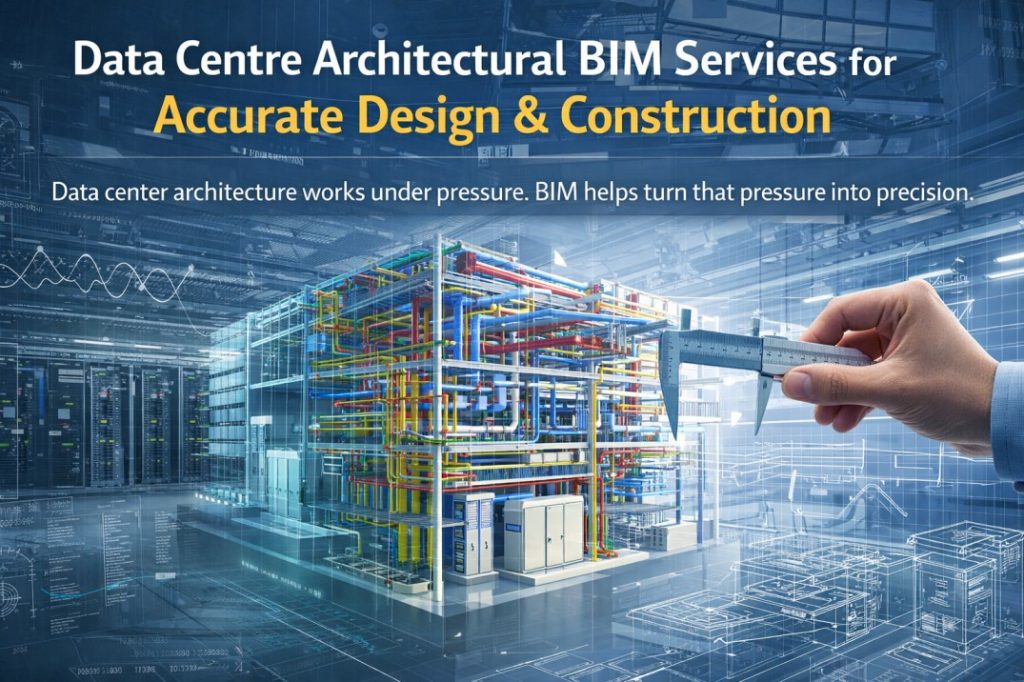
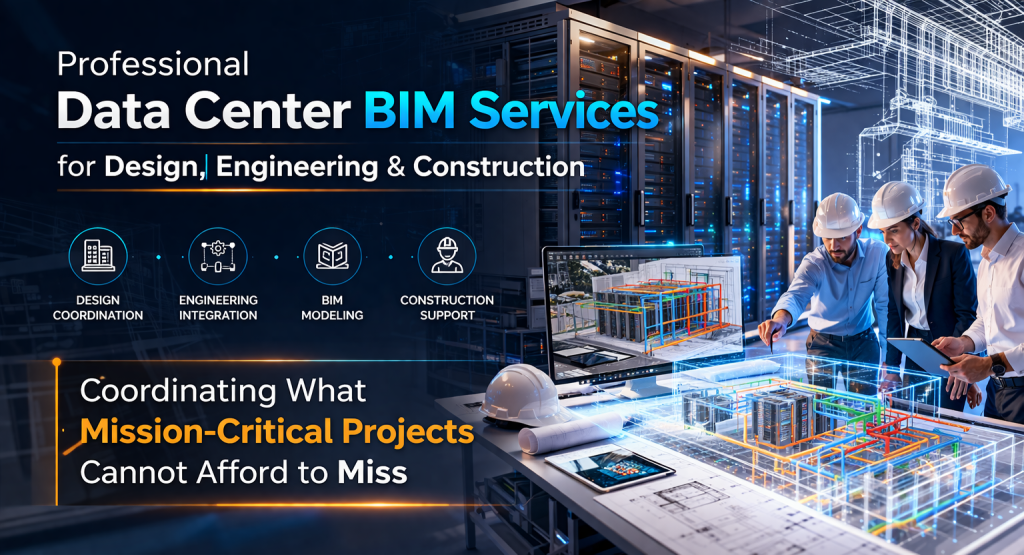
Data center projects demand a level of coordination that goes far beyond conventional building delivery. Mechanical systems, electrical infrastructure, structural framing, architectural layouts, and construction sequencing must all align within highly constrained environments. Facilities where even small coordination gaps can create serious downstream issues. This demand calls for professional data center BIM services delivered by experienced BIM consultants for data center projects.
At TopBIM company, we provide specialized BIM support as a trusted data center BIM services company for data center design, engineering, and construction teams working on complex, mission-critical facilities. Our role is to help project stakeholders develop coordinated and information-rich models that support reliable project outcomes.
As a dedicated data center BIM services company, we support projects with end-to-end modeling, coordination, and documentation across architectural, structural, and MEP disciplines. From early design support to construction-ready deliverables, our BIM workflows are built to reduce clashes, improve visibility across trades, and strengthen project control at every stage. For firms looking to outsource data center BIM services, we offer scalable delivery backed by experienced BIM specialists who understand the speed, density, and coordination intensity these facilities demand.
Our Data Center BIM Services
We provide complete BIM solutions for data center infrastructure projects across architectural, structural, and MEP disciplines, along with clash detection, scan-to-BIM, and construction documentation support. The goal is not simply to create models. It is to develop coordinated project information that helps teams make better decisions before issues reach the field.
Architectural BIM Modeling Services for Data Centers
Our data center architectural BIM services support architects, contractors, and developers delivering mission-critical facilities. Through architectural BIM modeling data center workflows, we create detailed models for design validation, space planning, and coordinated documentation.
Our scope includes:
- Architectural Revit modeling
- Data center layout modeling for server halls, corridors, and support areas
- Facade BIM modeling
These services are delivered by experienced architectural BIM consultants for data center projects and support teams seeking a dependable architectural BIM company for data center construction.
MEP BIM Services for Data Center Infrastructure
Our MEP BIM services for data centers support the modeling and coordination of mission-critical systems.
MEP BIM services include:
- Electrical BIM modeling for power distribution
- Plumbing and fire protection BIM modeling
- Integrated MEP coordination models
This helps teams review routing, clearances, and system coordination before installation.
Structural BIM Modeling Services for Data Centers
Our structural BIM services for data centers focus on detailed models that improve constructability and coordination.
Structural BIM services include:
- Structural steel modeling
- Concrete structure modeling
- Structural shop drawings
- Foundation modeling
These models help align structural, architectural, and MEP systems during construction.
BIM Clash Detection Services for Data Centers
Our clash detection services for data center projects help identify coordination issues before construction begins.
Services include:
- Clash detection using Navisworks
- Coordination between architectural, MEP, and structural models
- Construction coordination reports
Early detection helps reduce rework and installation conflicts.
Scan-to-BIM Services for Data Center Facilities
Our scan-to-BIM services for data centers help capture existing conditions for renovation, expansion, and upgrade projects.
Services include:
- Laser scanning and point cloud capture
- Conversion of point cloud data into BIM models
- As-built BIM model development
- Retrofit and renovation modeling
These models provide a reliable base for planning and coordination.
Each service supports a different part of the delivery cycle, but the real value comes from how they work together. In a data center, coordination is rarely discipline-specific for long. Architectural decisions affect MEP routing. Structural requirements affect service clearances. Existing conditions can reshape both design and execution. BIM becomes useful when it brings these dependencies into view early enough to act on them.
Why BIM Matters More in Data Center Projects
Data center BIM services has become more important because the facilities themselves are changing. AI-driven infrastructure is increasing rack densities and putting more pressure on power planning than many teams had to manage even a few years ago.
The International Energy Agency estimates that data centers used about 415 TWh of electricity in 2024 and projects that figure to rise to around 945 TWh by 2030, with AI as a major growth driver.
That shift makes coordination more consequential. In a conventional building, a clash may delay a package. In a data center, the same issue can affect power paths, cooling performance, access planning, and long-term operational reliability. That is why BIM consultants for data center projects now play a more central role in project delivery.
Why BIM carries greater value in data center projects
- Lower tolerance for coordination gaps: Dense system layouts leave little room for error.
- Power and cooling are mission-critical: Coordination issues can affect both constructability and facility performance.
- BIM supports functional planning: It helps teams review access, clearances, and equipment relationships early.
- Better multidisciplinary alignment: Architecture, structure, and MEP BIM services for data centers can be coordinated in one shared model.
- Stronger construction readiness: BIM helps reduce rework, improve sequencing, and support smoother execution.
Key Data Center Challenges BIM Helps Solve
In data center projects, risk often builds long before construction starts. It develops when dense systems are designed in parallel, reviewed in fragments, or advanced without a fully coordinated view of how they will fit and function together. Data center BIM services help teams identify those pressure points early, when decisions are still easier to test, adjust, and align.
Some of the most common challenges it helps address include:
- Congested service zones where architectural, structural, and MEP systems compete for limited space
- Cooling and power routing conflicts that create installation issues later in the project
- Coordination gaps between disciplines that lead to rework, drawing revisions, or site delays
- Late-stage design changes that become harder to absorb without a coordinated digital model
- Uncertain existing conditions in renovation or expansion projects
- Documentation inconsistencies between model content and construction outputs
In practical terms, BIM helps teams see problems while there is still time to solve them efficiently. That shift matters. Resolving issues in a model review is not the same as resolving them after procurement, installation planning, or field mobilization has already begun.
Multidisciplinary BIM Support for Mission-Critical Projects
Data center projects rely on a level of multidisciplinary coordination that standard delivery workflows often struggle to handle. Architectural layouts need to account for equipment zones and service movement. Structural systems need to support both building loads and infrastructure requirements. MEP systems need to route through spaces that are already constrained by architecture and structure. None of these scopes can be treated in isolation for very long.
That is why multidisciplinary BIM support is so important in mission-critical projects. It allows teams to coordinate across disciplines in a shared environment, test assumptions earlier, and identify where one scope begins to affect another. A capable data center BIM services company helps bring this coordination structure into place.
A coordinated BIM approach typically supports:
Discipline | BIM Support Focus | Why It Matters |
Architecture | Layouts, access paths, enclosure coordination, documentation | Preserves spatial intent and planning clarity |
Structure | Steel, concrete, foundation, support zones | Improves buildability and alignment with other systems |
MEP | Cooling, electrical, plumbing, fire protection | Supports routing, clearances, and system integration |
Coordination | Clash detection services for data center projects, review workflows, and issue tracking | Reduces rework and improves installation readiness |
Existing Conditions | Scan-to-BIM services for data centers and as-built modeling | Improves accuracy for retrofit and upgrade work |
The value here is not just technical completeness. It is project visibility. A multidisciplinary model gives teams a better way to understand how decisions travel across the project before those decisions become expensive to reverse.
How BIM Improves Data Center Constructability
Constructability is where BIM proves its value most directly. A model may begin as a design tool, but its commercial value often becomes clearest when it helps teams build more predictably.
In data center projects, BIM improves constructability by bringing geometry, system relationships, access conditions, and installation constraints into a coordinated environment before work begins on site. That allows teams to review not just whether something fits in theory, but whether it is workable in sequence, in space, and in relation to adjacent scopes. This is where BIM services for data center construction become especially valuable.
This can improve project delivery in several ways:
- Earlier identification of field conflicts
- Better coordination between trades
- Cleaner routing and access planning
- Stronger alignment between model content and shop drawings
- Fewer late-stage corrections during construction
- Improved confidence in package release and execution planning
What matters most is that BIM shifts coordination from reaction to preparation. In mission-critical work, that is not a minor advantage. It is often the difference between controlled delivery and constant adjustment.
BIM Use Cases Across New Build, Expansion, and Retrofit Projects
Data center BIM services are not limited to one project type. Their role changes depending on whether the project is a new facility, an expansion, or an upgrade to an operating environment.
- In new build projects, BIM supports multidisciplinary coordination from the start. It helps align architectural planning, structural systems, cooling, power distribution, and documentation before the project reaches construction.
- In expansion projects, BIM becomes especially useful where new scope has to connect cleanly with existing infrastructure. Teams need to understand how additional systems, spaces, or support zones will affect what is already in place.
- In retrofit or renovation work, BIM often depends on verified existing conditions. That is where scan-to-BIM and as-built modeling become important. Existing facilities rarely behave exactly as legacy drawings suggest, and digital models built from scan data give teams a more reliable foundation for design and coordination.
- In live-facility projects, the stakes are even higher. Phasing, access, downtime sensitivity, and working constraints all increase the need for coordinated project information. BIM helps teams plan around those realities with greater confidence.
What to Look for in a Data Center BIM Partner
Not every BIM provider is prepared for the coordination demands of data center work. A strong partner needs more than software capability. They need modeling discipline, project awareness, and an understanding of how BIM supports delivery under pressure. When evaluating a data center BIM services company, it helps to look for:
- Experience across architectural, structural, and MEP scopes
- Familiarity with mission-critical project environments
- Strong clash detection services for data center projects and coordination workflows
- Reliable documentation standards
- Scalable production capacity
- The ability to support fast-moving project timelines
- Model outputs that remain useful for real construction decision-making
The distinction matters because data center BIM is rarely judged by model completion alone. It is judged by whether the information supports coordination, reduces uncertainty, and helps the project move forward with fewer disruptions. That is also why many firms choose to outsource data center BIM services to specialized teams with mission-critical project experience.
From Model Development to Construction-Ready Delivery
A strong BIM workflow does more than move from one task to the next. It builds coordination maturity through the project.
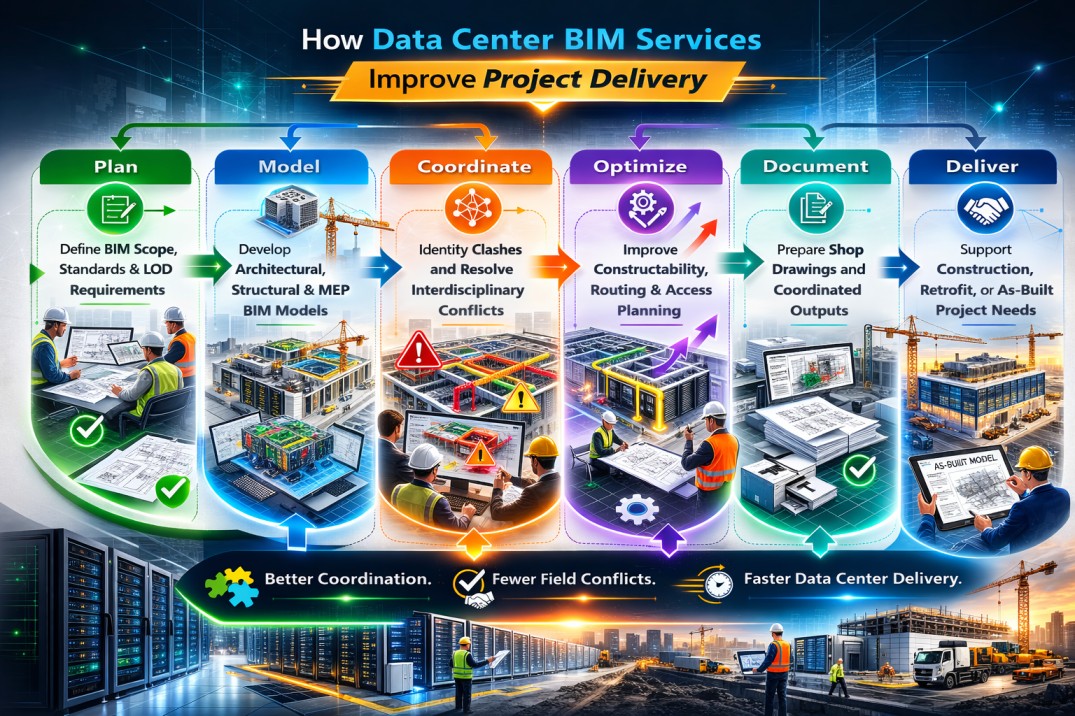
- For data center construction, that usually begins with planning. Scope, standards, LOD requirements, coordination expectations, and deliverables need to be defined clearly.
- From there, architectural, structural, and MEP models are developed based on available design information and project priorities.
- Once the base models are in place, coordination becomes the focus. Teams review how systems intersect, identify clashes, evaluate clearances, and refine model content to improve constructability.
- As the model matures, it begins supporting documentation outputs more directly, including shop drawings, coordination views, and model-based construction information.
A simplified delivery path typically looks like this:
Phase | Purpose |
BIM execution planning | Define standards, scope, and deliverables |
Discipline modeling | Develop architectural, structural, and MEP models |
Coordination review | Identify clashes and alignment issues |
Model optimization | Improve routing, access, and buildability |
Documentation delivery | Produce construction-ready outputs |
The point of this progression is not to make BIM feel procedural. It is to make it useful. In data center work, models only become valuable when they help teams deliver better information at the right time.
The real value of BIM in data center projects lies in helping teams act before coordination issues become construction problems. With better visibility into systems, space, and sequencing, project teams can move forward with fewer unknowns and stronger execution readiness. If your next data center project demands tighter coordination and more reliable delivery, expert BIM support can provide that foundation.